
.svg)
The phrase “looks good to me” is one used in software engineering. It’s abbreviated to “LGTM” and written during code reviews. It is also often associated with laziness and used ironically when a reviewer could not be bothered, or too time-poor, to actually read/understand the code.
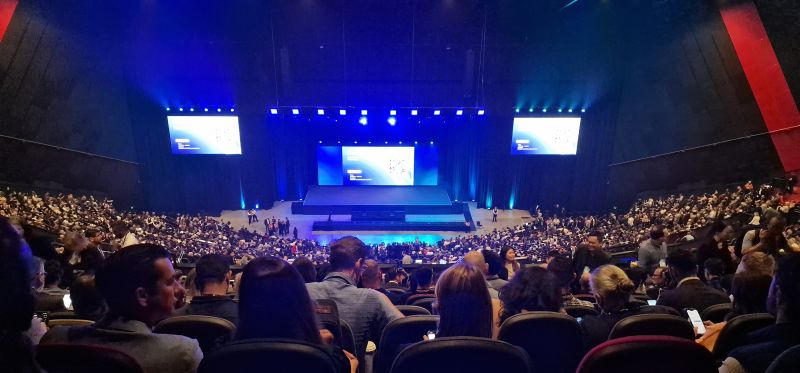
Last week, my team attended the Microsoft AI day at the ICC in Sydney. Satya Nadella gave an emotive speech about the role of Microsoft Copilot in the step change in the way we work. Integrating Copilot agents with MS Word, Excel, PowerPoint and Teams.
The demos that followed were what alarmed me:
The office worker uploads an excel spreadsheet and asks the Copilot agent to “Make me a slide deck to present this spreadsheet”. The agent generates a slide deck. “Looks good to me”.
The slide deck is shared on a group chat on MS Teams. A colleague asks Copilot to summarise the slide deck then asks a question. The user clicks the Copilot button instead of answering themself. Copilot answers. “Looks good to me” the person says.
User asks Copilot to incorporate the answer into the slide deck. The slide deck regenerates. “Looks. Good. To. Me."
The presenter of the demo’s unironic overuse of “LGTM” provides an unintended depth of insight into the possible future of work. AI agents generating content, AI agents summarising the content, AI agents asking and answering questions about the content and human workers being either too lazy or too swamped to review.
In this scenario, if AI is trustworthy and reliable then perhaps it’s not a problem. However, the devs on the floor at the conference confirm that that’s not the case. Hallucinations are the giant elephant in the room.
Now as a data scientist, I absolutely support the use of AI and believe it has the potential to boost productivity but putting these black box agents in the hands of the AI unsavvy has the potential to destroy productivity.
AI requires specific, custom sets of instructions and rigid workflows to achieve reliable, consistent, and accurate outputs (at a reasonable cost). Collaboration both subject matter experts and AI experts is required to develop and optimise towards what good looks. Once that has been determined, the process to create this content should be standardised and replicated. This is how real productivity is unlocked.
After Satya’s talk CEOs of Westpac and Telstra attended a panel. The sentiment was that integration of AI is a people problem and that proper education and upskilling is required. At Traffyk we find that it is impossible to make everyone an AI expert and that the education focus should be on “here is what’s possible with AI”. People are already expert in their own field, the most successful use their knowledge to answer the question: “what parts of my work could be faster, better, or entirely reimagined if AI was applied here?”