
Projected AI timeline (According to Tech Leaders)
2017 – Fully autonomous self-driving cars (2012 - Sergey Brin, 2015 – Elon Musk)
2020 – Full autonomous taxis (2019 – Elon Musk)
2025 – Artificial General Intelligence (2024 – Elon Musk)
2026 – Artificial General Intelligence (2024 – Dario Amodei, 2025 – Sam Altman)
2030 – Artificial General Intelligence (2025 – Demis Hassabis)
2030 – Artificial Super Intelligence (2025 – Sam Altman)
2034 – 40% of jobs automated (2019 – Kai-Fu Lee)
Innovation is a difficult thing to predict. This is because there are a large number of unknowns. How come a teenager can become competent at driving a car in 10 hours, yet our best AI models take 10,000 hours of training. Is it because that teenager is learning with emotion? They want independence, they want to impress their friends, they don’t want to let their parents down. Or is it something more primal, evolution has given us instincts that can identify threats and adapt for self-preservation quickly? We simply don’t know.
Many AI researchers are worried that we don’t have the silicon hardware required to replicate true intelligence. Let alone the ability to craft the mathematical functions required to replicate true learning and decision making.
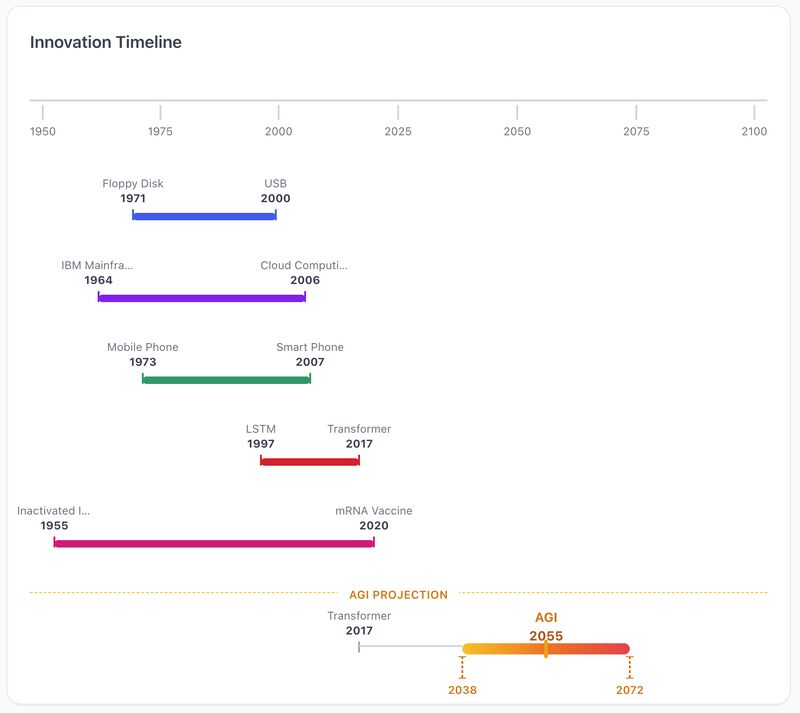
Something we do know is how long it has taken for past innovation to occur. I have done a rudimentary analysis estimating the number of years between concrete technological innovations. The average period is 38 years with a standard deviation of 17. The LSTM -> Transformer being the most relevant as it is the underlying technology behind our GenAI. If we assume that the next architecture leap after transformers unlocks artificial general intelligence (AGI) then this places it happening between 2038 and 2072, a far cry from the current tech leaders' projections save Kai-Fu Lee.
1 December 2025
Measure How Much Productivity You Could Gain With Our Calculator
Our productivity calculator reveals the potential costs Traffyk can save your business and improve productivity by when inefficient workforce communication is reduced.